Welcome to Necromancy for the Dead Inside.
For the plain text version, click here.
My name is Jae, and this is my culminating experience for my master of Instructional Design and Technology.
Necromancy for the Dead Inside is a 100 day / 100 prompt creative practice intending to help heal and restore the inner artist in us all. We are acolytes together in the process of resurrecting each other's inner artist.
How it works:
These 102 prompts are designed to help you think about creativity and art. We will do the prompts together, though asynchronously. You will be able to see what others before you have created from prompts and those coming after you can see what you choose to share!
While I encourage participating as close to daily as you can, I do not expect perfection from anyone. You can do prompts as you can, you can break a "daily" prompt up to be done over multiple days. This is your practice, you do it as you want.
What is needed / getting started
First, everything is a suggestion. Please adapt this practice to your own needs. For example, if you are visually impaired, you can use audio tools in lieu of the notebook and wall calendar.
Your grimoire: A notebook with at least 100 sheets
This is not just a notebook. This is your grimoire.
I prefer unlined pages, but lined or unlined is up to you.
Your grimoire is separated into ten sections of rites, rituals, spells, tips, and tricks to lead you out of the dark.
Color code the ten sections as you wish. You can color the top tenth of the page for the first 10 sheets, the second tenth for the next 10, and so on. You can color each section a different color. You can go back and forth, having the top section colored for one cycle and the bottom another—whatever fits you. Shit. You can even just tape in 9 ribbons to separate the sections. Just keep each 10-sheet (20-page) section distinct, so you can easily return to the rituals, spells, remedies, and guidance you gather in each cycle.
Your grimoire is your toolkit of spells and rituals that will help you along your way as you reanimate your artistic soul. We will work on workarounds to common problems, ways to get unstuck, and ways to move forward. You will write in here what works best for you. This will be, as grimoires usually are, unique to you. So when you are finished, you will have a book that guides you out of the dark.
I want this to be a physical book so you can easily flip through it when you are stuck and find the answers you have gathered for yourself. Plus, the act of physically writing, not typing, leads to widespread brain connectivity. And, you can doodle. Doodling isn’t just a fun artistic practice; it has been shown to be good for your mental health, help build creativity, and increase engagement.
A wall calendar
A 2023 study found participants assigned to paper calendars were more likely to complete scheduled activities than those using digital ones, apparently because paper supports a big-picture view of plans. Studies have also shown a physical calendar increases psychological commitment.
A blog
This is a little less optional. Pretty please have a blog.
The blog is where you will post your art, your process, and your reflections.
Research has shown that writing reflections after an exercise
improves transfer and retention,
deepens experiential learning,
and
is good for both mental and physical health.
The blog can be made private, public, or any mix of the above.
The inspiration for this project is the
educational theory of connectivism.
Largely, we learn through community.
Not a people person? That's fine. Neither am I. I had a panic attack yesterday because I couldn't be around people anymore. I GET IT!
But even for us hermits (maybe especially for us hermits) growth is best built in networks and learning lives in the ability to make connections (mental and social) across the networks.
Yes, that is some hippy shit. But also, it's backed by science.
Connectivism says knowledge lives in networks. Not just people - ideas, tools, notes, links, conversations, patterns. Learning is making connections and strengthening them. You don't have to love people to benefit from the network; you just have to participate in it. (please.)
WITH THAT SAID you can also set your blog to private. And this way you can look back at your growth through these projects. And maybe one day you'll want to share an entry. As I said above, this is YOUR practice. Yes, I have strong suggestions. But I'll still meet you where you are.
You can use any platform you wish, but here are some options if you don't know where to start.
Very easy (no setup):
Medium - https://medium.com
Blogger - https://www.blogger.com
Substack - https://substack.com
Tumblr - https://www.tumblr.com
Easy (some setup):
Weebly (what I use) - https://www.weebly.com
Wix - https://www.wix.com
WordPress.com - https://wordpress.com
LinkedIn (for writing posts/articles) - https://www.linkedin.com
Code-friendly / customizable:
Neocities (simple static sites) - https://neocities.org
GitHub Pages (host your own site) - https://pages.github.com
Jekyll (static site generator) - https://jekyllrb.com
This is a Neocities site. It's very easy to use if you can write basic HTML. (By the way, did you know the moon phase on the moon is accurate? That was NOT easy to code.)
You do not need to use all of these platforms. Choose one or two that feel manageable. The goal is not visibility, it is documentation and connection.
A Reddit account
Please make yourself a Reddit account and join our Reddit at https://www.reddit.com/r/CreativeNecromancy. Yes, I know. "Reddit? Ew!" But I wanted a forum where users could be anonymous, while still allowing moderation and removal of bad actors. The r/creativenecromancy subreddit is private, so only those undertaking this creative practice can see posts. You can make any username, so you can stay anonymous if you wish. This is the main shared space where we witness each other's work.
Please also follow us on Instagram at https://www.instagram.com/creativenecromancy/. There will be hashtags associated with every prompt so we can find each other's work across platforms.
Our Facebook group at https://www.facebook.com/share/g/1HpaBJDynA/ uses the same hashtags and allows for a bit more privacy, if that is a concern.
YouTube or something similar
A YouTube account is a good place to upload videos. YouTube has strong privacy controls. You can make a video private (only you can see it), unlisted (only people with the link can view it), or public. You can also subscribe to @creativenecromancy for updates or future video prompts.
Other video options with decent privacy controls include Vimeo, which supports unlisted links and, on some paid plans, password protection; and Dailymotion, which offers private and password-protected video settings.
Discord
Discord is fully optional, but it allows for real-time conversation with other acolytes. Join the Discord.
Rules
Meet yourself where you are!
Part of what has killed our inner artists is the need for perfection. We are not perfect. We cannot be perfect. As a fellow human, I also struggle with perfectionism. But we must fight that urge if we want to create.
This means:
Only dedicating the time that you have.
Making "daily" a couple days a week, weekly, or even monthly if you need.
Only sharing what you're comfortable sharing with who you are comfortable sharing with.
Skipping any prompts that make you uncomfortable or shaping the prompts to your needs.
The most important step is always the next step. It doesn't matter if you're running or if you're tip toeing. You do you. This will be here when and how you are ready!
All prompts are suggestions! (Rules are not.)
In the spirit of the first rule:
If I say to set a timer for 20 minutes and you want to do 5, do 5. You want to do an hour, do an hour.
If I tell you to blog one thing and you want to blog another, blog the one you want to blog.
As long as you obey these rules, you can change up what you want in the practice!
No criticism of any kind!
No criticism of any kind.
We do not criticise the works of others or our own work!
This includes things like:
"I would have ____."
"I would have liked to see it as _____."
"It would be better if _____."
"I like this, but _____."
NONE!
For many of us, it was criticism from ourselves and others that sent our creative inner artist to the grave. If we want to bring them back to life, we must offer support only. Even to ourselves. (Especially to ourselves!)
"I especially love the way you ______."
Comparison is the thief of joy!
While you may say who inspired you, do not compare your work to theirs. If they are further on their creative journey than you are, that is fine. We must all be beginners first. If they have been doing this for the same amount of time and you think their work is "better," that is also fine. We all move at different paces.
Please also do not compare other people's work to your own or other artists. You might think the person you're comparing them to is a genius, but you don't know how they feel about it. It's safest not to.
No bigotry of any kind, including dog whistles!
Yo, I will not fuck around here.
This also includes any homages to figures who are known bigots or oppressors.
I have been asked what a "dog whistle" is.
From Wikipedia: "In politics, a dog whistle is the use of coded or suggestive language in political messaging to garner support from a particular group without provoking opposition. The concept is named after ultrasonic dog whistles, which are audible to dogs but not humans. Dog whistles use language that appears normal to the majority but communicates specific things to intended audiences. They are generally used to convey messages on issues likely to provoke controversy without attracting negative attention."
It is common in our current political climate for people to say or do bigoted things and then claim they are not being bigoted. The intention is to express their prejudice without facing consequences.
This will not stand here. This is not that space.
Art is political.
I notice that in arts groups and crafting groups, people often complain about seeing politics. Art is inherently political by nature. You don't have to make your art political, but don't complain about anyone else's art being political unless that political expression breaks the bigotry rule.
The Prompts
Cycle 1: Getting (un)Grounded
1.1 What is art??
Before we can create, we have to know what we want to create. You might have an idea in mind, but also, there might be ideas out there waiting for you. Let's take some time to think on what art IS?
Choose your medium for writing- it can be a Google Doc, a pen and paper, the notepad app- whatever you want. Hell, you can make it your first blog entry! (Did you make your blog? Right now might be the perfect time!)
Set a timer for 10 minutes. Take that time and write out as many forms of art as you can think of. Think outside the box! We know painting on a canvas is art, but what about painting your house? Drag is art, but is putting on clothes? Pretty much anything can be art if you're creative about it. Take this time to explore various options for expressing your creativity!
Even this list is a form of art!
For extra points (there are no points) add your art forms to this Google Form to make a word cloud everyone can see!
Blog: If you did this on a doc, cut and paste your brainstorm into your blog. If you did this on paper, take a photo of the paper and put it in the blog. Take at least 5 minutes to reflect on this. You can write about what surprised you, what excited you, or what forms of art you want to explore more. If there are parts you want to keep private, feel free to make a private post. If there are parts you want to share, share them.
Grimoire: This ten prompt cycle will be about getting started. We will think on what art is and what arts we are interested in. We will practice self-love while we work. We will seek inspiration and work on just getting started. Give this section a title that reflects that. Write down the forms of art that most called to you and any you want to remember to explore later. Feel free to doodle too. If you can’t draw well now, that’s okay. Like everything else here, that gets better with practice. If you want to make it pretty but don't trust your hand, you can print out some online stensils to trace and color. Even that will get better with time.
Insta: If you're instagraming this project, take a screenshot or photo of your brainstorm, upload it, and hashtag it #cnwhatisart. Feel free to add a page from your grimoire too.
1.2 Getting your feet wet!
I highly recommend you record this time. You can store it on your machine or you can put it on your Youtube. You can make videos private if you don't want to share. But think about all the ways you've grown over the years, wouldn't it be great to have documentation of that growth?! Being able to look back on how far you've come will help you recognize and respect your growth.
First, let's refer to the word cloud we made with the last prompt. I will be updating this weekly, so don't fret if your words aren't there.
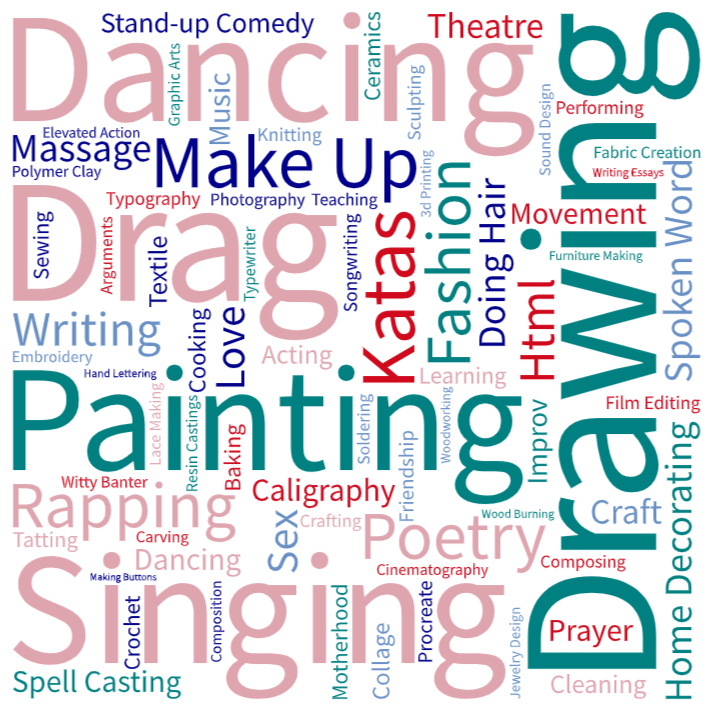
Then, with all these forms of expression in mind, take some time in any creative venture you want to play in. You can split time between them too, so long as at least 15 minutes is spent on each one. Practice self love as you begin.
You will not be perfect.
You will make mistakes.
You will sing out of tune.
You will mess up your shapes
you will get eyeshadow on your cheeks
You will mess up.
This is part of the artistic proccess!!!
Practice loving yourself for trying.
Practice understanding that everything has a learning curve.
You cannot be good at something without first being bad at it.
Spend some time practicing this patience, this compassion, and this embrace of yourself as a whole person who has imperfections. You will doubtless get frustrated at yourself anyway. That's okay. We are also learning self love and understanding. We will get better at that as we go too.
Blog: If you are practicing a movement or sound, record it. If you are making visual art, take photos - at the very least a photo of what you came up with in the end. Blog this. Don't worry, you can keep it private. But blog this for yourself or to share your creative journey when (and if) you are comfortable doing so. Take a few minutes to jot down your experience in the blog. Use words, use drawings... whatever you want.
Grimoire:Write down what helped you begin, what got in your way, and anything you want to remember next time. Take some time to doodle or sketch or color too.
Insta: Post what parts of this you feel best express what you got out of this practice and maybe this grimoire page. Hashtag #cnwetfeet.
1.3 Start Before You're Ready
Set a timer for 20 minutes and begin creating immediately with whatever materials are closest. No planning, no choosing "the right" thing-just start and keep going until the timer ends. Try not to "control" what is happening, just let your soul create.
Blog: If this is an action like singing or dancing, record it. (Remember you can make videos private on Youtube or on your blog.) If it is a visual art such as sculpting, painting, drawing, etc, take photos. I would encourage you to both post what you are comfortable sharing and a private post of what you made that you aren't comfortable sharing, but represent where you are on this creative journey. It will help you later to be able to look back and see how far you've come. Take some time to reflect on your emotions during this. Did you feel panicky? Calm? Constrained? Free? Could you feel it in your chest? Your stomach? Nowhere?
Grimoire: What got you moving? What helped you keep going once you had begun? Feel free to use words, diagrams, doodles, or sketches. If you feel stuck, take some time to color or draw. It will help you think.
Insta: Post what snippets you are comfortable sharing. Maybe just record yourself talking about it and showing what you did. Hashtag #cniwasntready
1.4 Make a Mess on Purpose
Have you ever seen a toddler dance? Heard a 4 year old sing? Seen what a child had scribbled on the wall?
Were any of those children ashamed? (Before being reprimanded?)
This is what we are trying to get back to!
Not the mess, but the lack of self-doubt! So let's do it like we did before we learned to be ashamed!
Set a timer and make something intentionally messy, excessive, awkward, or ugly. Do not fix, edit, or clean it up-stop when time is up and document what you made.
Fight the urge to be perfect. Embrace your inner toddler.
Blog: PRETTY PLEASE!!! What a great thing to get to look back at later! Do it for me?!?
Post what you made. Reflect on the blocks you felt while doing this. What did perfectionism sound like? How did you fight through it? What did it feel like to let yourself make something messy, excessive, awkward, or ugly on purpose?
Grimoire: Make a page for fighting perfectionism. Name it what you will. Write down the tricks that help you stop trying to be good and start letting yourself make a mess. Don't be all ironic and try to make this page perfect.
Insta: I mean, obviously it's up to you. But this could be such a fun thing to share with everyone! Hashtag #cnmessybish
Prep for next time: Be thinking about what you have left behind because your inner toddler learned to be ashamed. Start thinking on what you want back.
1.5 The Abandoned Art
Pick at least one creative practice you used to do and stopped. Spend 30 minutes in this creative practice. (IE: If it's drawing, draw for 30 minutes. If it's dancing, dance for 30 minutes.)
You will not be as good as you once were!!!
That's fine. That's to be expected.
Now is the time to practice self love, patience, and compassion for your inner artist.
Blog: Record yourself working, post your highlights. If you worked in a visual medium, post photos. Choose whichever visibility (just you, friends only, public) you are comfortable with. Take at least 5 minutes reflecting on your emotions during this practice. Was it soothing? Did it stress you out? Did it feel like visiting an old friend? Also list what strengths you still have or what you feel you are better at than you thought you would be. If nothing, don’t worry. We’ll get there!
Grimoire: Write down what helped you come back to your abandoned art: what tools you need, what setup helps, what kind of warm-up works, what makes re-entry easier, and what tends to stop you before you begin. This page should help future-you return with less dread and less friction.
Optional Insta: Share a photo, clip, or a few seconds of you returning to this old creative practice. Hashtag #cnunquitting
Prep for next time: Be thinking about an art you've wanted to try but never have. We're gonna try it!
1.6 The Art You Never Tried
Pick at least one creative practice you have always wanted to try but never actually tried. Spend 30 minutes in this creative practice. (IE: If it's painting, paint for 30 minutes. If it's poetry, write poetry for 30 minutes.)
You will not be good at it yet!!!
Of course not, you've never done this before! The first step to being good at something is being really, really, really bad at it!
Again, please practice self love, patience, and compassion for your inner artist.
Blog: Record yourself working and post your highlights. If you worked in a visual medium, post photos. Choose whichever visibility (just you, friends only, public) you are comfortable with. Take at least 5 minutes reflecting on your emotions during this practice. Was it fun? Intimidating? Did you feel like a child learning to walk? Also list what you are better at than you thought you would be. If nothing, don't worry. We'll get there!
Grimoire: Write yourself some tips for the next time you try a brand new art. Include things like how to determine what materials you will need, how to organize that list, where to procure them, what kind of help to look for, what to do when beginner panic hits, and what to tell yourself so you actually begin instead of freezing.
Optional Insta: Post what feels right to share about this first attempt. Maybe it's the finished project. Maybe it's the mess you made. Maybe it's you talking about the process. You do you! Hashtag #cnbadbettergood
1.7 Seek What Inspires You
Let's have some fun here!
Spend time finding inspiration. It can be an artist, song, poem, image, performance... it can be other online artists, it can be music, it can be videos, it can be anything. I made this collaborative Spotify playlist, this YouTube playlist (for any videos that meet all the stated rules, not just music), and this post in the CreativeNecromancy subreddit. Share as much as you want!
When you find something that really inspires you, take some time with it. Let it get into you. Then spend at least 10 minutes making an homage. It doesn't need to be in the same medium. Just your soul's response.
Again, remember, it doesn't have to be "good." Just what you feel. If you feel stuck, borrow one element (mood, rhythm, color, shape) and translate it into your own version.
Blog: Post some of the things that most inspired you and why. If you feel comfortable, share your homage.
Grimoire: Start an inspiration bank. Keep a list of artists, songs, poems, images, performances, colors, moods, and anything else that sparks you. Add links if you can. This page is for future you when you feel dry and need somewhere to start looking. Maybe also start building your digital grimoire, where you will keep links to things that help you create. Note the location here so you don't forget.
Optional Insta: Make a video (you don't have to show your face if you don't want to) discussing what you found most inspiring. Please make sure to credit the artist. Maybe tag them if they're on insta. Hashtag #cninspiration
1.8 Use Your Body
Create through movement, gesture, posture, voice, rhythm, breath, or physical action.
This does not have to mean "dance" in any formal sense. It can mean swaying, stomping, pacing, stretching, reaching, voguing, making weird noises, drumming on a table, humming, walking while speaking lines aloud, or tracing shapes through the air with your hands. Adapt this to your ability. You don't need to dance Swan Lake, do what you can with what you have.
Spend at least 15-20 minutes letting your soul move you.
Blog: Record a short clip if you want, or describe how it felt letting your soul lead your body. Reflect for at least 5 minutes. What blockages did you feel? Were you able to push through them? Were you embarrassed even if alone? Did you feel free? Constrained?
Grimoire: Write a ritual for getting out of your head. Make a list of physical things you can do to access creativity through your body. This can be pacing, stretching, swaying, stomping, humming, drumming on a table, tracing shapes in the air, speaking lines aloud, or anything else that works for you. This page is for the days when thinking is getting in the way.
Optional Insta: Post a clip, still, or reflection. Hashtag #cnmybodymyvoice
1.9 Start a Major Project
Choose a project you want to do for the remainder of this practice. This will not encompass all the remaining prompts, but will appear once or twice in each of the next nine ten-day cycles. As mentioned previously, "This can be anything: a quilt, a website, an opera, teaching your class to dance the Thriller, a set of poems, one long poem, a new drag persona, a drag performance. It can be as big or as small as you want. You can make it contained in the next 9-15 instances of this practice, or you can make it something that starts here and continues on after you finish the prompts. It is all up to you."
Spend some time in preparation. Figure out what you will need. What supplies might you need? What skills might you need to learn? What do you already have? What is missing? Make notes in your notebook about all of this. If you find while doing this that the project is too big, trust that instinct. We aren't ready to paint the ceiling of the Sistine Chapel.
When you have settled on the project, and if you have enough of what you need, take some time to plan how to start. And maybe, if possible, spend five or ten minutes beginning the work.
If you want to keep going beyond the five or ten minutes, keep going.
You can also work on this outside of the prompts. Just make sure to document your experiences with it in the blog.
Blog: Share what project you chose and why. Talk about what you think it will need from you, what supplies or skills you may need, and whether you were able to begin. How do you feel about this? Excited? Anxious? Enthralled? Are you having a panic attack?
Notebook: Most of the prompt happens in your notebook. Document what you have and what you will need to get this done.
Optional Insta: Share your project idea, your planning page, your supplies, or your first baby step. Hashtag #cnitbegins
Cycle 1 Reflection
Take at least twenty minutes to reflect on the first cycle of this project. What worked? What didn't? What blocks got in the way? What surprised you? What did you learn about yourself as an artist? If you skipped anything, why? Were there any prompts you especially loved or hated? (You can totally redo ones you loved! No one is stopping you!)
Choose at least one thing you want to take with you into the next cycle and at least one thing you want to do differently.
Blog or Notebook: Write or record your reflection in whichever you choose.
Blog or Notebook: In the other one, summarize the biggest thing you learned in just a few sentences.
Optional Insta: Share one thing that surprised you about this first cycle, or one thing you want to carry into the next one. Hashtag #cnfirstcycle
Cycle 2: Casting the Circle
2.1 Commit to Continue
You made it through ten prompts. That's actually huge! But it's just the start!
Cycle 1 got us on our feet, Cycle 2 will establish the ritual. But first, let's make some commitments.
Yes. Yes. We're all afraid of commitment. But make a promise to yourself to continue on this journey.
Take a moment (at least five) to reflect in your blog or notebook. Think about what you want from yourself going forward. How often are you going to practice? Is there a set day you want to practice? Days? Time of day? Take this time to write out what you want from yourself.
But remember, perfection is the enemy of good. If you miss a day, don't fret. Life happens!
Blog or Notebook: Put whatever promises to self you landed on in whichever you didn't use for the musing.
2.2 Gather Your Tools
This prompt may take some days, so feel free to do other prompts as you do this one.
Refer to the notes you made in the "Start Your Major Project" prompt. Use your notebook for this. Make a checklist of the things you need (you can also do this on your blog if paper isn't easier). Start gathering the supplies you need. Remember, you don't need to spend a lot of money. You can find things at thift shops, on craigslist or FB marketplace. Maybe a friend you know might have extras. You can buy new, but youdon't have to.
Make a space for your supplies.If you are able, gather your supplies in a place that you will see them as you move about your abode. If not, put them together in a bag. Make separate bags for the art you have quit, the art you never tried, and the major project (if the major project doesn't already fit into one of those two categories).
Blog: Blog your haul. Introduce us to your favorite tools! Where did you find it? What do you plan to do with it? Why are you most excited about it?
Optional Insta: Show us your haul and your favorites. Maybe give us a video about them. Hashtag #cntools
2.3 Work on Your Digital Grimoire
Practitioners of olde had books because they didn't have the tech we have. Yes, our physical grimoires are helpful, but they can't directly link to videos or websites. For that, we have a bookmarks bar.
Find tutorials online. These can be for the whole skill (ie: how to do drag) or specific skills you will need (ie: makeup tutorials, how to do makeup for thin lips, how to choose your lipstick shade, etc.)
If you want to buy a whole ass book for any of these skills, you can! (Save a tree, buy used!) But also, YouTube or internet tutorials are plentiful. Spend at least half an hour searching out tutorials. Feel free to make a post in our Reddit either sharing your favorite tutorials or asking for others' favorite tutorials on the same subject. You can also find appropriate Reddit subs. But be careful out there if you're not a seasoned Reddit user. It can be a very toxic space.
You can also find tutorials on Instagram or Facebook groups. Be creative. But make sure to keep track of sources you have luck with. Keep your blog open and pop links into the entry for this prompt so that you have easy access to them going forward. I also encourage you to pop them in your bookmark bar, but those can be lost when switching computers.
Notebook: Reflect on the experience. Were you surprised by how much there was? How little? Did you struggle to find things?
Optional Insta: Give some love to the creators who make the tutorials you will be using. Make sure to tell them what you're doing and what you have found helpful. They are, after all, fellow practitioners, and even a practitioner with a billion followers deserves to be told what they're doing right! If you make your own Insta post, use hashtag #cngrimoire
2.4 Raise the Rite
Before we get to this prompt, let's discuss ritual. There are a lot of data that show that rituals can be deeply healing. My rituals are going to be witchy because I practice Wicca. But yours do not have to be. If you want something more Buddhist, more Sikh, more Catholic, you do you! Adapt the ritual in a way that is authentic to you and your beliefs. It is important that there is ritual. What the ritual actually is is up to you.
What can we do to let us know it's time to create? This can be anything and it's up to you. It could be lighting a candle, putting up your hair, putting on an apron if painting, sculpting, or cooking, making yourself a cup of tea. It can be a phrase or sentence spoken out loud.
Take some time and brainstorm ideas in your blog or notebook. Maybe it's a mixture of a few or many things. Light a candle and say the words to summon the creative spirit. Maybe take a moment in darkness and silence to still your mind.
Just find something that makes you feel ready. You can try these out as you practice going forward. Just like you try on many pairs of shoes before one fits, you may have to try many rituals. And, just like shoes, maybe you want to have many fo different moods or different practices.
One note: I would like to discourage the use of substances in the ritual only because we do not want our creativity to be reliant on our being in an altered state.
Blog and Notebook: Brainstorm this in either your blog or notebook, whichever is easier for you to write down many ideas. In the other, neatly collect your favorite ideas so that you can try them going forward and note the success of them.
Optional Insta: Post your ritual setup, be it a chalk circle or a cup of tea. Hashtag #cntheritestuff
2.5 The Abandoned Art II
Use the abandoned art from Cycle 1 that most spoke to you. If none did, go back and do that prompt now, then return to this one after you've found one you want to move forward with. If there is no abandoned art that you want to move forward with, you can start using a secondary "Art You Never Tried" in place of an abandoned art in the Abandoned Art prompts.
Going forward, we're going to begin with what we've assembled for the ritual. We're going to use some tools we've found, a tutorial we saved, and a ritual to set intention.
Spend at least 30 minutes on this practice as you get more comfortable with your tools and learn a skill from your tutorial. This is not about making something pretty, this is about honing your craft.
Even with the new tools and the tutorial, you are still learning. So let's remember to practice self love and be patient as we learn!
Blog: Share which tools, tutorials, and rituals you used. Share what you learned and what you struggled with. Set an intention for what you want to work on going forward.
Notebook: Spend at least 5 minutes on your reflection. Was it easier this time? Was it still awkward? Did the use of the tutorial make you feel intimidated? Supported? Stymied? Set your intention going forward.
Optional Insta: Share what you're comfortable sharing from this practice. Hashtag #cnbackonmyartshit
2.6 Dispel a Creative Injury
Focus on a memory of being criticized, shamed, graded, or discouraged creatively. On a piece of paper, write as closely as you can remember to the words that hurt you. Take some time focusing on how you will let go of this creative injury.
Reflect on the injury. If there is truth to it, accept it as neutral. I absolutely do dance like a duck. Nothing wrong with that. My singing voice is breathy. But "too breathy" is an opinion. Frankly I suck at applying lipstick. That final one is something I want to work on. Is there one here you want to work on?
Remember the Serenity Prayer:
God, grant me the serenity
to accept the things I cannot change,
courage to change the things I can,
and wisdom to know the difference.
Use the Serenity Prayer for your art. Is it something you can change? Is it something you even want to? If it is something you can change, identify how important it is to you that you do. If it is not important to you, breathe it out. Say the words to let it go while exhaling. Do this multiple times until you feel it.
Focus on your breathing as you reflect on this.
When you are ready, burn the paper with the injury written on while focusing on letting go. Speak the words of your emancipation. Some practitioners like to write little rhymes for this. Some just state it plainly. Do what feels more powerful for you.
Notebook: Reflect on the hurt. Reflect on why it hurt. Is it true? Is it just someone else's opinion? Is it something you can change? If not, accept it. Add to your reflection how that felt.
Blog: Highlight what you identified and the action you are taking. Are you letting this go? Are you accepting it as neutral? Are you deciding it is something you actually want to work on? Share what feels right.
Optional Insta: Make a video of you writing the harm, burning it, and saying the words you chose. If you don't want to share the exact harm, that's fine. You can film the ritual without showing the words. Hashtag #cnletitgo
2.7 The Art You Never Tried II
Use the art you never tried from Cycle 1 that most spoke to you. If none did, go back and do that prompt now, then return to this one after you've found one you want to move forward with.
Going forward, we're going to begin with what we've assembled for the ritual. We're going to use some tools we've found, a tutorial we saved, and a ritual to set intention.
Spend at least 30 minutes on this practice as you get more comfortable with your tools and learn a skill from your tutorial. This is not about making something pretty, this is about honing your craft.
Even with the new tools and the tutorial, you are still learning. So let's remember to practice self love and be patient as we learn!
Blog: Share which tools, tutorials, and rituals you used. Share what you learned and what you struggled with. Set an intention for what you want to work on going forward.
Notebook: Spend at least 5 minutes on your reflection. Was it easier this time? Was it still awkward? Did the use of the tutorial make you feel intimidated? Supported? Stymied? Set your intention going forward.
Optional Insta: Share what you're comfortable sharing from this practice. Hashtag #cnstilllearning
2.8 It's the Little Things
Choose one specific skill to work on. For example, if you're learning swing, maybe it's a triple step. If you're learning makeup, maybe it's contouring or lip lining. If you're learning embroidery, maybe it's one more complicated stitch. These are just examples, it can be anything.
Find a tutorial for that detail if you can. If not, find one that is similar enough to help you learn the skill.
Spend 30 minutes on this one detail. See how slowing it down, breaking it apart, and learning a specific skill can improve your craft!
Remember self love! Even the little things can be hard. It's actually always the little things that are hard, we just lose that detail when the little things make the whole thing seem hard. Learning all the small things makes the big thing so much more doable.
Blog: Share what detail you worked on, what tutorial you used, and what you learned.
Notebook: Reflect on how focusing on the detail shaped your view of the whole. Did it make it seem harder or easier? Did it make the whole seem larger? Smaller? How did it shape your perception of the whole? How did it shape your perception of learning the craft?
Optional Insta: Share your practice on that one detail if you want to. Hashtag #cnshesellsdetails
2.9 Setting the Stage
Sit down with your major project. Map out what you want to work on today. Take a minute to reflect on what physical and mental tools you need and gather those. Consider what skills you need. If they are skills you are weak in, maybe watch a tutorial. Remember that planning is part of the process. Make sure you make your space, both physical and mental, ready for your work. Spend at least half an hour working.
Notebook: Notate what tools you thought you needed and any tools that you realized you needed after starting. Make note of the physical tools and mental tools. Should you have gotten yourself a glass of water or a cup of tea? Should you have taken a moment in silence first? Or put on some music? Notate what worked with your physical space. What worked with your mental space? How did focusing on your environment help your artistic flow?
Blog: Blog all you needed to be fully prepared.
Optional Insta: Take some shots of your fully prepared workspace. Maybe some shots of the small details. Maybe your teacup. Maybe your favorite tool. Hashtag #cnstagecraft
Cycle 2 Reflection
Take at least twenty minutes to reflect on the second cycle of this project. What did you learn about your needs as an artist? What physical tools did you need that you didn't anticipate? What mental tools did you need? Which ones mattered less than you thought? Did gathering tools, tutorials, and rituals make it easier to begin? Did anything surprise you?
Reflect on your abandoned art, the art you have never tried, and your major project. Did any of them feel easier this cycle? Harder? More exciting? More intimidating?
Reflect on how you felt after releasing your creative injury. Did anything change for you? Did it help you view yourself differently? Are there pieces of that injury you want to keep letting go of, or pieces you want to work on?
Choose at least one thing you want to take with you into the next cycle.
Blog or Notebook: Write or record your reflection in whichever you choose.
Blog or Notebook: In the other one, summarize the biggest thing you learned in just a few sentences.
Optional Insta: Share one thing that helped you this cycle, or one thing you want to carry into the next one. Hashtag #cnsecondcycle
Cycle 3: Sharpening Your Edges
3.1 Cycle 3 Intention: Finding Your Voice
By now we should be starting to see some patterns, some preferences, some weird little tendencies. It's very normal to push back against things we think are different, especially about ourselves. But those little things you do, those little things you reach for unintentionally, those little things that make your art different... those things you get made fun of for- those are what make you great. If all art were the same we wouldn't have Picasso or Frida Kahlo or really any of the greats.
Your differences are what make you you.
I said when we started this that perfection is the enemy of the good. But it's also the enemy of the great. Because what is perfect to one is bland to another and what some see as flaws, others see as genius.
This cycle is about finding the little gems inside of you and polishing them so they can shine in their unique brilliance.
That does not mean sanding off your edges. It means sharpening them. It means paying attention to what keeps showing up in your work. What are you drawn to? What do you keep reaching for? What feels natural to you? What do you do that feels different from how other people do it?
Spend 30 minutes reflecting in your notebook or blog on what makes your work unique. What tendencies are showing up? What weirdness keeps returning? What are you going to stop apologizing for? What will you lean into this cycle?
Set an intention for this cycle around finding your voice.
Blog or Notebook: Spend 30 minutes reflecting on what makes your work unique and set an intention for this cycle around finding your voice.
Blog or Notebook: In the other one, take 5 to 10 minutes and reflect on how this makes you feel. Do you feel freed? Scared? Exposed? Look deep and be honest.
Optional Insta: Share your intention for the cycle, or one thing that makes your work feel uniquely yours. Hashtag #cniwasbornthisway
3.2 Stop Apologizing for One Thing
In the last prompt, you reflected on what makes your work yours. Now I want you to choose one thing to stop apologizing for.
Maybe it is something in your style. Maybe it is something in your voice. Maybe it is a tendency you see as a flaw. Maybe it is something people criticize you for. Maybe it is something you have been trying to hide, soften, or clean up.
Pick one.
Write it down. Make a sigil for it. To make a sigil, write a word or phrase about what you are claiming, remove any repeated letters, and combine the remaining letters into a symbol. Don't think too much. Just let your body and soul create it. It does not have to look like anything to anyone else. It is just for you! Light a candle. Look yourself in the mirror and speak the words of your emancipation to your own face.
This is obviously just a suggestion. But make a little ritual of acceptance. Do not leave the spell until it is complete. Just like you do not stop an exorcism before the demon has left the body, do not stop until the apology has left your mouth.
Then spend at least 30 minutes creating while letting that part of yourself exist without apology. You do not have to exaggerate it (yet). You do not have to defend it. Just let it exist. Let it take up space.
This is not about deciding that every habit is genius. It is about not treating one part of yourself like a problem-- accepting yourself as a whole.
Blog: Share what you chose to stop apologizing for and what ritual you used to claim it. How did it change the work to let that part of yourself stay?
Notebook: Reflect on how it felt to stop apologizing for this. Did you feel relieved? Exposed? Powerful? Stupid? Honest? Did it feel like voice, fear, or both?
Optional Insta: Share one thing you are done apologizing for in your work, or share the ritual you used to claim it. Hashtag #cnsorrynotsorry
3.3 Abandoned Art IIIA
Go back to your abandoned art. But this time, don't try to make it neater, prettier, safer, quieter, or more acceptable. Let your whole self show up in it. Feel the change from your un-apology ritual. Bring it into your work. People say your food is too spicy? Make it spicier. You think your voice is too deep? Hit those bass notes! Do you have a tendency to shade too dark? Make it darker.
Let's see what happens when you stop trying to make yourself fit into the box society has convinced you to fit in. Spend at least 30 minutes with this art, without trying to conform to anything. This does not mean you have to make it bigger, louder, messier, or more dramatic than it wants to be (unless that's what you want!). It just means stop trying to file off your edges while you work.
Blog: Share what happened when you let yourself show up more fully in this art. What felt more like you? What did you notice yourself reaching for? Did anything surprise you?
Notebook: Reflect on how it felt to work this way. Did you feel freer? More exposed? More awkward? More honest? Did anything in this abandoned art start to feel more alive when you stopped trying to behave?
Optional Insta: Share what you're comfortable sharing from this round with your abandoned art. Hashtag #cnloudandproud
3.4 Too Much? Bet.
So last prompt we let the thing exist. This time, we're taking it to its logical conclusion. We're going to stretch the walls of this cage.
Choose which art to work on. It can be the abandoned, the new, or the major project. Though don't do anything on the major project you can't undo if it's "too much." Because right now "too much" is what we're going for.
If they say you sing too breathy, sing breathier. If they say your food is too salty, experiment with some famously salty dishes. If they say you dance too stiff, dance stiffer.
Push it to its edge. Because the true you is probably somewhere between where you are now and this cliff. Spend at least 30 minutes pushing it as far as you can. Find the edge of comfort and push past it. You think this is all you got? Bet.
Blog: Share what you did and how it felt. Do you love what you did? Do you hate it? Does it inspire you? Scare you? Make you want to push the other way? (You can totally try that too!)
Notebook: Reflect on how you felt pushing this limit. How did it feel in the moment? How do you feel afterward? What did you get from this exercize?
Optional Insta: Post your mess and your feelings about it. Hashtag #cnbet
3.5 The Art You Never Tried IIIA
We are still pushing past the limits we've been taught to accept. We're going to keep pushing those limits with your new creative practice.
Take a minute and think on another detail you want to work on. Maybe your website feel is too 90s? Find a tutorial for a specific skill and make that skill as 90s as you possibly can! (I'm here for the MIDIs, yo!) Maybe you're told the bowls you throw are wobbly. Find a tutorial for a skill you need to learn, but while learning it, make them wobblier. They think your jewelry is gaudy? Gurl, hold my round-nose pliers while I learn wire wrapping.
We are going to learn new skills, but adapt them to our needs. Though, at this point, the caricature of our needs.
Spend at least half an hour learning how to be extra extra in this new skill.
Blog: Share how this felt. Was it fun? Did trying to be extra get in the way of learning? Did it make you push outside the lines of the lesson to learn in your own way? What did you get from this?
Notebook: Reflect on what this told you about taking direction. Reflect on how this made you feel about your path forward as an artist.
Optional Insta: Share the gaudiest parts with a caption about this being the extreme version of your voice. Hashtag #cnextraextra
3.6 Stretching It Out
Now that we've played with one unique characteristic, we can play with others. It's important to note you don't have to shoehorn yourself into something just because it comes out in your early work. The point of these exorcizes isn't so much to force you to have this particular voice, but to help you feel out options and to quit seeing uniqueness as a fault.
So today we play.
What other tendencies do you have that you fight against?
Let's be very careful here and acknowledge that you should fight against tendencies that are harmful to yourself or others. A good example is the tendency all of us have to be perfectionist or just generally be too hard on ourselves. Or to give up if something is hard. Or to feel we're not good enough. Those tendencies we need to fight. When we are talking about tendencies here, we're talking about an overuse of the color red or making the eyes too big/ small/ close together on sculptures.
Anyways. Today we play. Work on either the art you abandoned or the art you never tried. Play with your uniqueness. You can play by pushing back against it (if you sing too loud, sing too quietly) or you can play with other eccentricities you've noticed in your arts.
Spend at least half an hour playing with your art focusing on your differences. If you want, pull up a tutorial and work on a skill while allowing yourself to do it differently.
Blog: Share what tendency or eccentricity you played with and how you played with it. Did you push against it? Lean into it? Try both? What did you learn?
Notebook: Reflect on how it felt to play this way. Did it make you feel freer? More confused? More curious? Did anything feel more like you? Did anything surprise you?
Optional Insta: Compare your work before this exorcize to your work after it. Hashtag #cnstretch
3.7 Abandoned Art IIIB
Now we will return to the abandoned art and just relax into it, letting your authentic self show up in your art. Remember that many masters take years to find their voice and we're only 36 prompts in. So we're just going to work on our art.
We can just practice, we can just make something, we can do a tutorial making sure to adapt to our own needs. Remember to practice self love. We're less than 40 prompts in and this is only the 4th focused on this art. We're still in the early stages of learning. Obviously, we're still going to make mistakes. Or, as Bob Ross would say, “We don’t make mistakes, we have happy accidents.”
Take at least 30 minutes to just sit down with your craft and your practice and your compassion for self and remember why they call it a creative "practice."
You can just practice. You can just make something. You can do a tutorial, making sure to adapt it to your own needs. You can work on a skill. Do what you need to do today for you.
Blog: Share what you worked on and what, if anything, seemed to feel more natural and more you.
Notebook: Reflect on what authenticity means to your art right now. What does it mean to you to try to find your voice?
Optional Insta: Share the part that felt most like you. Hashtag #cngottabeme
3.8 Take Only What You Need
It's really great how ubiquitous and easy to find tutorials are. There are tutorials for just about everything. But just as this website has my fingerprints all over it, most tutorials are going to teach you in the teacher's voice. And this can mean it's hard to find how to do what we want the way we want to do it.
This doesn't have to be a problem.
Let's take me for example. I've made jokes in here about my thin lips and my struggles with lipstick. I have naturally thin lips which have thinned further with age (Gen X in the house!), plus I have facial paralysis that makes them uneven and a scar that makes following the lip line impossible. I have watched at least a hundred makeup tutorials and every stinking one of them says to use light colored lipstick. I'm a GenX goth girl. You ain't getting me in pink lipstick! nothankyou!
I can learn from these tutorials how to shape outside the lines or how to make lines where there aren't any or how to add volume without having to listen to the constant cries of "Dark lipsticks thin lips."
Long example, I know. But the point is that you have to learn how to take what you want and leave everything else behind.
So that's what we're doing today. Take at least two tutorials and learn from them what you want. Spend at least 30 minutes on this.
Notebook: Reflect on what you took with you and what you left behind. Did you struggle to ignore the parts you didn't need? Did it make it easier? What did you learn about your relationship with your art from this practice.
Blog: Link the tutorial, tell us how you felt about it, and show us what you changed.
Optional Insta: Post what you did. If possible, compare it to the tutorial's intended outcome. Hashtag #cntakeonlywhatyouneed
3.9 The Art You Never Tried IIIB
We've let ourselves show up. We've pushed it too far on purpose. We've played with our weird. We've learned to take what we need and leave the rest. Now let's go back to the new art and bring all of that in and see what happens.
Spend at least 30 minutes with your new practice. You can make something new. You can practice a skill. You can do a tutorial, making sure to adapt it to your own needs. You can do whatever you want! Just make it your own!
Remember to practice self love and patience! We are still beginners! We might be farther on the learning curve, but it’s still early. I said the first step to being good at something is being really, really, really bad. Well, it’s still early enough that bad is good. And if it’s not? If it’s good? Well, that’s great! But be sure to not judge any work on the last thing you did, because we all have good days and bad days.
Blog: Share what you worked on and what felt more like you this time around. Did anything in this art start to feel more natural or more you? What parts of this art are starting to feel like they belong to you? What parts still feel like wearing somebody else's shoes?
Notebook: Reflect on what has changed since the first time you tried this art. How does it feel different now? What still feels hard? What feels exciting? What feels like it might be part of your voice? What are you learning about yourself as an artist?
Optional Insta: Share what you're comfortable sharing from this round with your new art. Hashtag #cnallmine
Cycle 3 Reflection
This cycle we took a “fault” and stopped apologizing for it. We worked on taking what makes us unique and putting it into our art. We practiced making radical self acceptance our voice. So let’s take a minute and reflect on how to take that with us.
Spend at least 30 minutes in your notebook or blog reflecting on what you learned this cycle, but also what you still need to learn about bringing self-love and acceptance into your art.
How can sharpening your edges make your art better? But also, how can sharpening your edges make your life better? We all spend so much time and energy trying to fit into boxes made for other people, how would our lives be improved if we just didn’t?
Reflect on what it felt like to commit to no longer apologize for something in your art and how it would feel to do the same for yourself as a person.
Blog or Notebook: In the other one, make a commitment to yourself to work on accepting something else about you. Do you talk too much? Maybe that’s why your friends like you. Think of something you want to work on embracing about yourself and write yourself a commitment to work on that.
Optional Insta: Share your favorites from this cycle and tell us what makes them your favorites. Hashtag #cnlucretia
Cycle 4: Banishing Resistance
4.1 Cycle 4 Intention: Banishing Resistance
I never want to go to the gym. I literally cannot tell you a time where I woke up in the morning and was like, “Oh hell yeah! It’s leg day!” But I always feel great afterward. Art is the same way. Sometimes it just feels like so much effort. But it’s always worth it.
This cycle is about resistance. We need to learn to see it for what it is and learn to get through it. The problem is that resistance is not always obvious. Sometimes it looks like fear wearing your own face.
And before we get carried away, let’s be clear about what resistance is not.
Caring for yourself or your pets or your loved ones is not resistance. You should prioritize the health and love you are surrounded with. So if your dog needs a walk, that isn't resistance. If your daughter wants you to read to her, take that time. If you need to eat, pause your timer. Art is important, but it isn't as important as you or those around you.
Once real needs are cared for, then we can look honestly at what is getting in our way.
What do you do to think? If I knew you were like me, I’d tell you to take a walk or bake something. But I don’t know you like you do. Whatever it is you do to think, do this for about a half hour. Do it thinking on how you resist. What do you do to get in your way? Do you suddenly need to clean your house? Are you suddenly just too tired to function? Do you just feel uninspired? Do you pick some stupid fight with yourself right before you begin?
If your notebook is nearby, write things down as you think of them. If your computer is nearby, open your blog and note in it when ideas hit you. If not, send yourself messages (text, voice, email... whatever works) and consolidate them later.
Blog or Notebook: Spend 30 minutes reflecting on how resistance shows up for you (or transfer your reflections here).
Blog or Notebook: In the other one, spend at least five minutes setting your intention for how we will learn to banish that resistance.
Optional Insta: Share your intention for the cycle, or one way resistance tends to show up for you. Hashtag #cnbanishingresistance
Not all resistance is bad. Like Cain Culto says, F Trump, F Ice, Free Palestine!
4.2 Return to the Major Project
Now that we are talking about resistance, let's go straight to where it likes to hide: the big work.
Go back to your major project. Spend a little time first thinking on what resistance looks like here. Does it tell you the project is too big? Too messy? Too far gone? Too important to mess up? Does it tell you that you don't know enough yet, that you don't have the right tools, that you'll ruin it if you touch it?
Resistance has had its say. Now work anyway.
Take at least 30 minutes and do something for the major project. It does not have to be huge. You do not have to solve the whole thing. You do not have to fix every problem. You just have to move it. Add something. Revise something. Practice something. Sketch something. Test something. Organize something. Touch the project and leave evidence that you were there. If you want to take time to find and watch a tutorial for a skill here, stop your timer. You absolutely can take time to learn, but right now we are committed to taking 30 minutes to DO.
Remember: the point here is not perfection. The point is not brilliance. The point is to keep relationship with the work, even when the work feels heavy.
Notebook: Reflect on what you worked on and what resistance you felt while you were doing it. Did you need to clean your kitchen? Did you suddenly remember you haven't brushed your teeth today? Did you need to look up something for work? How hard was it to fight it? Did you find any little workarounds, like writing the note on the corner and pushing forward? How did it work and how did you work through it?
Blog: Show what you made and tell us what you had to fight to get it done.
Optional Insta: Share the best parts of what you made today and tell us what you had to fight to get through it. Hashtag #cnresisttheresistance
4.3 Start Without Mood
Sometimes resistance is just not being in the mood.
And that's natural. But we have to learn to keep going anyway.
Today is about doing it even if you don't feel inspired or whatever.
Look at your three projects — the abandoned art, the art you never tried, and the major project. Pick the one you least want to do today. Today we practice resilience.
Set a timer for 30 minutes. Do your starting ritual and then work on your art. If you take time to watch tutorials, pause the timer unless you are working alongside it. Pay attention to your mood while you work. Does the resistance fade once you begin?
Notebook: Reflect on when (and if) the resistance faded. Was it enough to just show up? Did starting the movement get you there, or were you just going through the motions? Reflect on how it felt to push through and keep going anyway.
Blog: Post what you did today and how easy or hard it was to start and to keep going once you started.
Optional Insta: Post the best parts of your work today. Hashtag #cnwerkbabywerk
4.4 Name and Ignore a Critic
Resistance isn't always just a vague feeling. Sometimes it's an active voice.
I used to live with a therapist. (2/10. Do not recommend. :p) Occasionally she would say some shit that made sense. I once told her that I always heard my father's voice taunting me when I did something stupid. She said "It's been a decade since you talked to that asshole. At this point, it's your own voice."
That shit was like a punch in the gut. But it was true. After a while, we internalize the voices from others and continue their abuse long after they're gone. We also internalize the voices of those we see every day. A complete stranger tells you your research is stupid and you remember that shit every time you write a new proposal.
The voices in our head might have someone else's face and voice attached to them, but they are, in the end, our own voices. This makes a simple exorcism much more complicated. But, as we have previously discussed, ritual can be a very powerful tool in our healing toolbox.
Name it. What is this voice? What does it always say? What lie does it keep repeating? Tell it how it is wrong.
If you want, you can make a whole ritual of casting it out:
Optional ritual: Cast it out
How do you bannish an entity? You name it. You call it what it is. You tell it it does not belong. You tell it it is no longer welcome. You cast it out. You cleanse what it touched. You ward your space so it can't wander back in like the world's shittiest roommate.
If you need some help choosing banishing words, here are some options:
“I name you and I reject your claim on me.”
“You are not my voice. You are not my truth. You are not welcome here.”
“By my will and by my word, I cast you out.”
“You have no place in this mind, these hands, or this work. Be gone.”
“I banish you from my art, my practice, and my body.”
To cleanse and ward your space, it can be as simple as organizing your work station, washing your hands, or cleaning your tools. It can be something as traditional as sweeping salt to and out the doors or placing selenite or black tourmaline. Do whatever feels right for you. This is your ritual.
Then work on one of your arts for at least 30 minutes without obeying that voice.
Notebook: Reflect on what the voice said and how hard it was not to obey it.
Blog: Share what you worked on and what the voice was trying to pull while you were doing it.
Optional Insta: Share what you're comfortable sharing from this practice.
Recommit
Make a short recommitment statement and then do 10-20 minutes of actual making to seal it. Document both the statement and the action.
Start Without Mood
Set a timer and work even if you don't feel inspired. Make something anyway and document what happened once you started.
Simplify Radically
Choose one simple structure (two colors, one shape, one sentence length, one movement). Keep it simple the whole time and document what you removed.
Return to Abandoned Art IV
Return again to the abandoned practice and do a short "practice session" rather than a finished piece. Document what you did and how it felt.
Begin Something Risky
Choose one thing that feels slightly risky (a topic, a form, a performance, a style). Do a first attempt and document the risk you took.
Homage: Recreate a Gesture
Choose an artist and focus on one gesture or move they use (brushstroke style, cadence, camera angle, dance step). Recreate that gesture in your own piece and document the reference.
Change Location
Work in a different location than usual (floor, kitchen, outside, different room). Make something there and document what the location changed.
Name and Ignore a Critic
Write down a critical voice you hear in your head (real or imagined). Then work for the full time while refusing to respond to it, and document what it tried to say.
Work on Major Project IV
Do one sustained session on the major project with a timer. Document what moved forward and what still feels stuck.
Cycle 5: Testing the Waters
Review Progress
Look back at your documentation and choose one thing that's improved (not quality-consistency, bravery, range, stamina). Write it down and document evidence.
Integrate Lessons
Pick one lesson from this cycle and use it in a short creative session. Document how you applied it.
Restart with Intention
Write one sentence about what you're aiming for this cycle (e.g., "more play," "more honesty," "more time"). Then work for the time block and document whether you stayed aligned.
Exaggerate a Tendency
Identify one natural tendency (messy, minimal, repetitive, dramatic, quiet). Exaggerate it on purpose for the full time and document what you learned.
Return to Abandoned Art V
Return again and do a small, repeatable version of the practice. Document what makes returning easier now.
Try a Tool You Avoid
Choose one tool or method you avoid (ink, voice, dancing, color, scissors, editing). Use it for the full session and document what you feared.
Homage: Steal a Structure
Choose a piece you love and steal its structure (beginning/middle/end, verse/chorus, composition layout). Fill it with your own content and document the source.
Slow Way Down
Work slower than is comfortable-deliberate marks, long pauses, careful movements. Document what slowing down reveals.
Respond to Old Feedback
Choose one piece of feedback you've carried (even if it was "helpful"). Make something that refuses to obey it, then document the response.
Work on Major Project V
Do one concrete build step on the major project (add content, refine a section, rehearse a piece). Document the step and the next one.
Cycle 6: Honing the Craft
Notice Energy
Note when you had energy and when you didn't this cycle. Document one condition that supports energy (time of day, music, location, silence, etc.).
Integrate Forward
Choose one change you'll carry into the next cycle and write it down. Then do 10-20 minutes of making using that change and document it.
Begin Midstream
Start working immediately in the middle of something-no warm-up, no introduction. Document whether starting midstream changes your resistance.
Limit Your Palette
Choose a limited palette (colors, sounds, words, movements) and stick to it. Document what the limit forces you to prioritize.
Return to Abandoned Art VI
Do the abandoned practice again, but focus on showing up, not results. Document how your relationship to it is changing.
Attempt Something Complex
Pick something slightly more complex than usual (layering, longer piece, multi-step). Attempt it for the full time and document what broke down.
Homage: Translate Across Media
Take inspiration from one medium and translate it into another (song → drawing, poem → movement, photo → writing). Document what you translated and from what source.
Use Repetition
Choose a simple action and repeat it (marks, lines, steps, phrases) for most of the session. Document what repetition does to your mind and the work.
Confront a Block
Identify one block that shows up repeatedly (starting, finishing, sharing, choosing materials). Do a session designed to confront it directly and document what helped.
Work on Major Project VI
Put a timed session into the major project and complete one defined chunk. Document what you completed and what's next.
Cycle 7: Claiming your Voice
Document Insights
Write down 3 insights from this cycle (about process, energy, fear, tools). Keep it blunt and document them for later.
Integrate and Rest
Do a short creative session, then stop intentionally. Document both what you made and how it felt to stop on purpose.
Restart After Rest
Restart with a small piece and a timer-no catching up. Document the restart and what made it easier or harder.
Break a Rule
Choose a rule you follow in your work (neatness, realism, grammar, symmetry, "no singing," etc.). Break it deliberately for the full time and document the rule you broke.
Return to Abandoned Art VII
Return again and do the practice with less self-commentary. Document how often you judged yourself during the session.
Begin Without Instructions
Choose a medium and start without a plan or reference. Keep going for the full time and document what emerged.
Homage: Reinterpret a Theme
Choose a theme you see in work you love (loss, desire, power, humor, decay, tenderness). Make your own piece on that theme and document the influence.
Change Your Pace
Work at a different pace than usual (faster, slower, stop-and-start). Document what pace does to your choices.
Act in Spite of Doubt
Set a timer and work while letting doubt exist in the room. Document the doubts you had and what you did anyway.
Work on Major Project VII
Do one focused session on the major project and leave a clear note for future-you about the next step. Document both.
Cycle 8: Braving Exposure
Notice Satisfaction
Identify one moment this cycle that felt satisfying (even tiny). Document what created that satisfaction.
Integrate Choice
Choose what you're emphasizing next cycle (range, depth, courage, consistency). Document the choice and do a short session aligned with it.
Start Where You Are
Work with your current conditions (energy, time, space) without trying to "optimize." Make something within those constraints and document the conditions.
Make Something You Would Hide
Make something embarrassing, crude, overly emotional, or unfinished - something you would normally keep private. Do not fix it; document it privately.
Return to Abandoned Art VIII
Return again to the abandoned practice and do it in a way that feels lighter or more playful. Document what makes it feel different now.
Try a Public Form
Make something intended to be shown (a short post, a simple video, a small image)- but sharing is still optional. Document how it felt to make "as if public."
Homage: Echo an Influence
Choose a clear influence and intentionally echo it in your work (style, voice, structure). Document who/what you echoed and what you changed.
Use Your Voice
Create using your voice (speaking, singing, sound, reading aloud), even if it's awkward. Record a short clip or write a description afterward.
Reject a Limiting Story
Write one limiting story you tell yourself ("I'm not an artist," "I'm too old," etc.). Then make something that contradicts it and document the shift.
Work on Major Project VIII
Do a timed session on the major project and produce a tangible piece (draft, sketch, take, section). Document what you produced.
Cycle 9: Holding the Thread
Review What Changed
Compare early work to recent work and identify 2-3 changes (risk, stamina, honesty, variety). Document evidence.
Integrate Courage
Choose one courage habit you want to keep (posting, trying, starting, finishing). Do a short session that uses it and document why it matters.
Begin Without Outcome
Start a piece with no intention of finishing or improving it. Work for the full time and document what happens when outcome isn't the goal.
Work with Scarcity
Limit yourself to very few materials or tools today. Make something anyway and document how scarcity changes your inventiveness.
Return to Abandoned Art IX
Return again and focus on consistency over quality. Document that you showed up and what helped you do it.
Try Something Awkward
Choose something that feels awkward (new medium, new subject, movement, voice). Do it for the full time and document what felt awkward and why.
Homage: Borrow a Method
Borrow a method from an artist you admire (daily sketching, looping, collage rules, structure). Use the method for one session and document the source.
Alter Your Routine
Change one part of your routine (time of day, music/silence, lighting, place). Create under the new condition and document the difference.
Act Against Old Fear
Choose one fear that still drives avoidance and do a small action that challenges it. Document the fear and the action.
Work on Major Project IX
Do one session on the major project that aims for completion of a piece or a section. Document what you finished or advanced.
Cycle 10: Closing the Circle
Document Growth
Write down what grew across the last cycles (not "better art" -more range, more honesty, more return). Document concrete examples.
Integrate Confidence
Choose one practice you now trust (timer, homage, constraint, movement). Use it in a short session and document why it's reliable.
Start the End
Begin a piece that acknowledges you're nearing the end of the 100 days. Make something that feels like closing or summing up and document the intent.
Simplify One Last Time
Strip your tools down and make something simple on purpose. Document what you kept and what you removed.
Return to Abandoned Art X
Do one last deliberate return to the abandoned practice as an act of respect for persistence. Document what you want to keep doing after Day 100.
Begin What Continues
Start a piece or plan that clearly continues beyond the 100 days. Document what continuation looks like for you.
Homage: Thank an Influence
Choose one influence and make a piece that thanks it (explicitly or quietly). Document the influence you honored.
Use Stillness
Spend part of the session in stillness or quiet attention, then create from that. Document what stillness changed.
Release a Final Block
Name one block you're ready to stop obeying. Make something that ignores it and document what you released.
Work on Major Project X
Do a final focused session on the major project that brings pieces together or clarifies next steps. Document what's complete and what continues.
Final Reflections and Extra Prompts
Reflect on 100 Days
Review your documentation and write a blunt summary of what changed, what didn't, and what mattered. Document it as a final record.
Decide What Continues
Decide your next cadence (daily/weekly) and the tools you'll keep using. Write a simple plan with a first date/time and document the decision.
Work for a Fixed Time
Okay. This one might be jarring, because when the timer goes off, you're out of time. Think of it like one of those cooking shows.
You choose your time constraint. But be wise. If you choose an hour, you have to work for an hour. If you choose too little, you'll stop in the middle of genius (which is actually kind of the point.)
This prompt is about enoughness. It's about setting a boundary for yourself and sticking to it. But also about leaving something that you will get back to later. (And you will!) It's about being able to stop something before you are done.
Set the timer and go. But work up to the timer and stop when the timer goes off. No "Just one more line!" No polishing. No fixing. STAHP!
Blog: Share what you did and what you wish you had time to keep doing. Share how the unfinished feels inside you.
Notebook: Reflect on what it felt like knowing you had a time constraint. Was it anxiety-provoking? Were you able to calm yourself? Did the impending timer get in the way of creativity? Or did it give you a feeling of control?
Optional Insta: Share a video of the work you did and explain what you feel the time constraint added or took away. Hashtag #cntimergobzz
Prep for next time: Be thinking about a project you want to do for the remainder of this project. This will not emcompass all the remaining prompts, but one or two per the next 9 ten day cycles. This can be anything: A quilt, a website, an opera, teaching your class to dance the Thriller, a set of poems, one long poem, a new drag persona, a drag performance. It can be as big or as small as you want. You can make it contained in the next 9-15 instances of this practice or you can make it something that starts here and continues on after you finish the prompts. It is all up to you. We will delve into this more next.
Work with One Constraint
Pick one constraint (one tool, one color, one word, one movement) and stick to it the whole session. Make something within that limit and note what the constraint changed.
Try a Different Medium
Choose a medium you don't usually use (sound, collage, movement, ink, clay, etc.). Stay with it for the full time and document what it forces you to do differently.
Homage: Translate an Artist
Pick an artist you love and study one piece for 10 minutes. Then recreate one element (composition, rhythm, palette, tone) in your own way and document the link/influence.
Change Your Scale
Make something much smaller or much larger than you normally would. Keep the scale change the whole time and document what it did to your choices.
Integrate What Stuck
Choose one tool or practice that actually helped (timer, constraint, movement, homage). Use it for a short session and document why you're keeping it.
Begin Again
Start with a new piece today even if you're mid-project. Make something from scratch for the time block, then document what it felt like to begin again.
Claim the Insult
Write down one criticism that stuck with you (e.g., "too thick," "too weird," "dance like a duck"). Then intentionally exaggerate it on purpose for the full time and document the result.
Try the Opposite
Identify your default style (busy/clean, loud/quiet, fast/slow). Then do the opposite for the whole session and document what changed.
Homage: Copy One Element
Choose a work you love and pick one specific element to copy (line thickness, rhythm, structure, phrase length, gesture). Copy only that element and make everything else your own, then document the source.
Use Found Materials
Make something using only materials you didn't "buy for art" (packaging, receipts, sticks, junk mail, objects). Keep it to found materials and document what you used.